Key Highlights
- Small business loans help manage both day-to-day operations and long-term growth.
- Loan approval depends on factors beyond eligibility, including purpose and financial behaviour.
- Strong documentation, such as bank statements and proof of income, supports better outcomes.
- Flexible repayment options and tailored loan terms help align with business cash flow.
- Maintaining a good credit score and financial history improves business loan eligibility.
Running a small business comes with daily challenges, and unexpected expenses often show up when you’re least prepared. It could be a supplier delay, a sudden equipment breakdown, or an urgent need for working capital. In these situations, access to quick funding can make all the difference.
What makes the situation harder is not just access to money, but knowing which option actually fits your business. With multiple loan types, varying eligibility criteria, and different repayment structures, many business owners struggle to assess what works for their scale, cash flow, and stage of growth. The lack of clarity often leads to hesitation or decisions that do not fully support long-term stability.
This blog simplifies your search for funding. We’ll walk through the key aspects of small business loans in India, including benefits, eligibility, documents, and more, so you can confidently find the right option for your business needs.
What Are Small Business Loans in India?
Small business loans in India are financing options that allow a business owner to access capital for clearly defined needs such as managing operational gaps, funding business expansion, or stabilising cash flow during uneven revenue cycles. These loans are offered by banks, NBFCs, and digital lenders, and may be structured as secured or unsecured business loans depending on the business profile and eligibility.
Beyond providing funds, small business loans play a role in financial planning and continuity. They help small enterprises align borrowing with business cycles, choose a suitable type of loan, select appropriate loan amounts and repayment tenures, and plan growth without disrupting day-to-day operations. Understanding factors such as business loan eligibility criteria, interest rates, and repayment structure helps businesses make informed borrowing decisions.
Disclaimer: Loans are subject to credit approval and verification. Terms and conditions apply.
What Are The Eligibility Criteria For Small Business Loans In India?
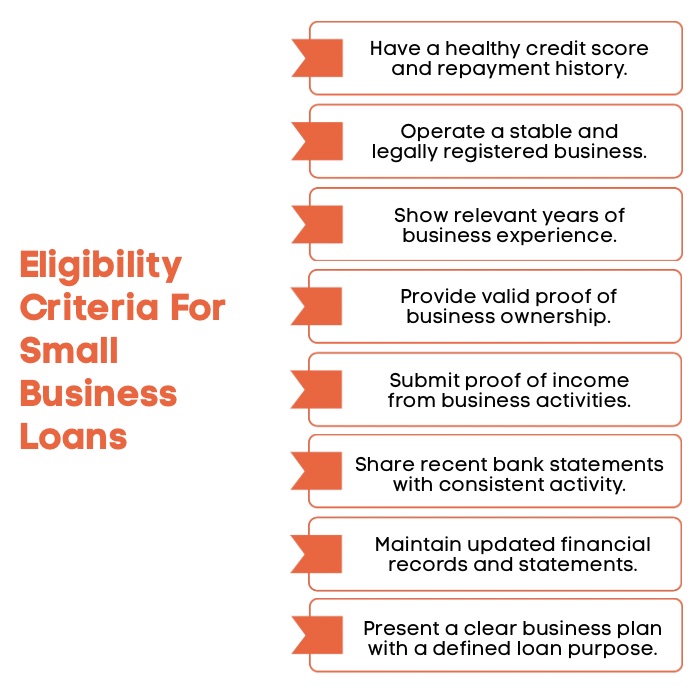
The eligibility criteria for a small business loan in India can vary across lenders, but most financial institutions look at a core set of factors to assess whether an applicant qualifies. These checks help lenders understand how stable your business is and whether you can manage repayments alongside daily operations.
Common eligibility factors include:
- Credit Profile: Lenders review your credit score and overall credit history to understand how you have handled previous borrowing.
- Business Background: The nature of the business is assessed to see whether it operates in a stable, seasonal, or high-risk segment.
- Business Experience: Years of business experience are considered, as a longer operating history often reflects consistency and reliability.
- Ownership Verification: Proof of business ownership is required to confirm that you are authorised to apply on behalf of the business.
- Income Assessment: Proof of income helps lenders evaluate whether the business generates sufficient earnings to support repayments.
- Banking Records: Recent bank statements from your bank account are used to analyse transaction patterns and cash flow.
- Financial Performance: Financial statements provide insight into revenue, expenses, and the overall financial health of the business.
- Business Planning: A clear business plan can strengthen your application by showing how the funds will support your business needs.
Meeting the business loan eligibility criteria does not guarantee approval, as service providers may apply additional checks during the application process. Reviewing these small business loan requirements in advance and keeping documentation organised can improve your small business loan eligibility.
Disclaimer: Loan approval and processing timelines for applicants with low CIBIL scores depend on lender criteria and cannot be assured. Funds can be used for any lawful purpose.
What Documents Are Required For A Small Business Loan Application?

When applying for the best business loans for small businesses in India, having the right paperwork in place is essential. It not only speeds up the application process but also improves your chances of approval by giving lenders a clear picture of your business’s financial health and operations.
Here are the key documents typically required when applying for a small business loan:
- Proof of Business Ownership: Documents such as a business registration certificate, partnership deed, or GST registration serve as proof that you legally own or represent the business.
- Proof of Income: Income tax returns (usually for the past two to three years), profit and loss statements, and other financial documents help lenders assess your earnings and repayment capacity.
- Bank Statements: Recent bank account statements (typically for the past 6 to 12 months) show how your business manages cash flow and whether there are regular credits and debits.
- Financial Statements: Audited balance sheets and cash flow statements reflect the financial standing of the business and support your application with clear financial insights.
- KYC Documents: Basic identity and address proofs like PAN, Aadhaar, passport, or utility bills are needed for both the business and the business owner.
- Business Plan: Some lenders may ask for a business plan, especially if you’re applying for a larger loan amount. A clear plan helps justify the purpose of the loan and how you intend to repay it.
- GST Returns: Providing GST filings, if applicable to your business, offers further evidence of income consistency and tax compliance.
Submitting complete and accurate documentation ensures a smoother experience, minimises back-and-forth with service providers, and helps demonstrate your business loan eligibility.
Disclaimer: Submission of required documents does not guarantee loan approval. All applications are subject to lender verification, eligibility assessment, and credit evaluation as per applicable policies.
What Are The Benefits Of Small Business Loans In India?
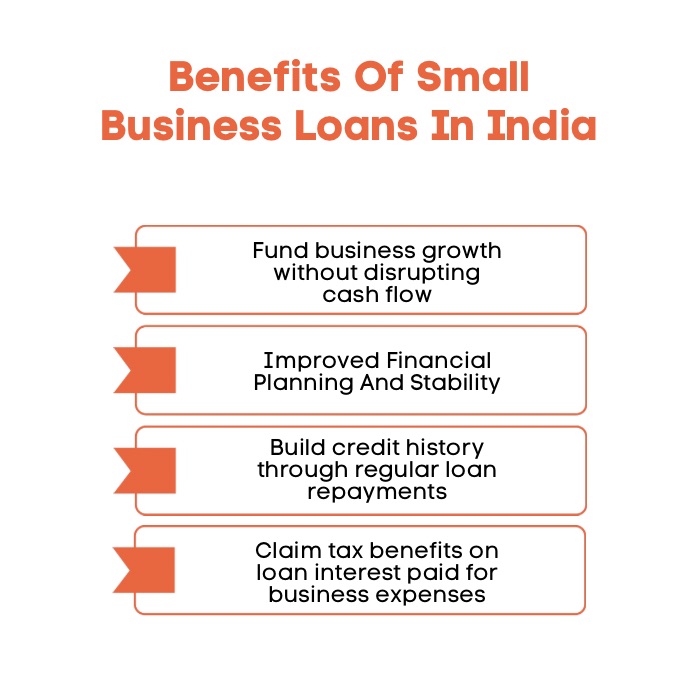
Small business loans offer more than just short-term funding. They help business owners manage growth, stability, and long-term planning across different stages of the business journey. From managing routine costs to preparing for expansion, the right loan can support both immediate and strategic goals.
Here are some of the key benefits small business loans offer:
1. Access To Capital For Growth
One of the biggest advantages of taking a loan is the ability to fund growth without disrupting cash flow. Businesses can use the funds to scale operations, invest in technology, hire talent, or support business expansion. Choosing a suitable loan tenure and flexible repayment options allows businesses to align repayments with revenue cycles and ongoing financial needs.
2. Improved Financial Planning And Stability
Small business loans provide structure to financial planning by spreading large expenses over a defined repayment period. This allows businesses to manage capital needs more predictably, avoid sudden cash strain, and maintain operational stability while planning for growth.
3. Building Business Credit
Repaying loans on time helps strengthen your CIBIL score and build a reliable credit history. Over time, this improves your relationship with financial institutions and supports stronger business loan eligibility. A consistent repayment record also increases the chances of accessing higher funding in the future on better terms. Credit scores are calculated by credit bureaus, and timely repayment does not always guarantee an increase in score.
4. Tax Benefits
Business loans can also offer tax-related advantages. In many cases, the interest paid on a loan can be treated as a deductible business expense, subject to applicable tax laws and professional advice, helping reduce the overall tax burden. This makes borrowing a more efficient way to manage larger business expenses while keeping finances structured and compliant.
Small business loans offer practical, goal-driven support to help businesses move forward with clarity and control.
Disclaimer: Approval decisions and processing timelines for low CIBIL profiles are subject to lender assessment and may vary.
What Are The Factors Influencing Small Business Loan Applications?
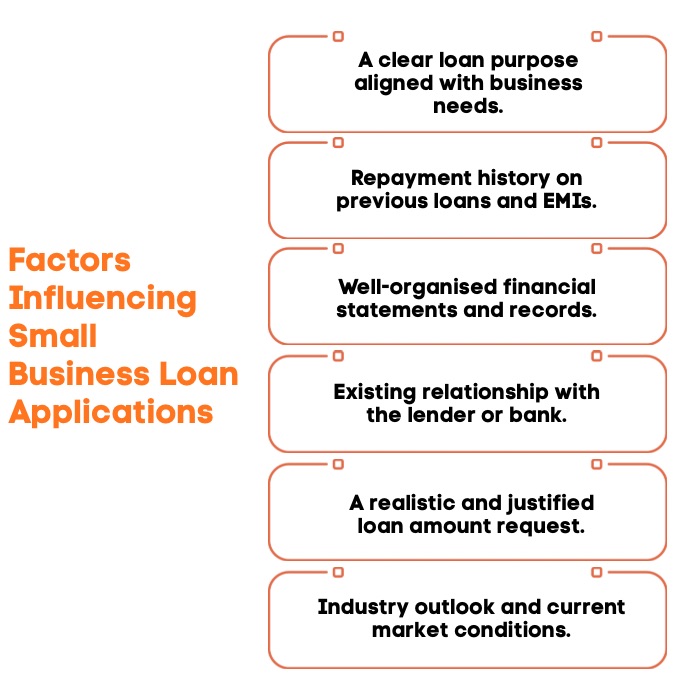
Meeting basic eligibility criteria and submitting the required documents only confirms that your application can be reviewed. What actually determines the outcome is how lenders interpret your business profile, borrowing intent, and financial behaviour once the evaluation begins.
Here are some of the most important factors that can shape how your loan application is assessed and the terms you may be offered:
1. Purpose Of The Loan
A clearly defined loan purpose helps lenders assess how the funds will contribute to your business goals. Whether it’s to support daily operations or fund business expansion, well-articulated use cases strengthen your application.
2. Loan History And Repayment Behaviour
Your repayment behaviour on previous business or personal loans can affect how lenders view your reliability. Missed payments or defaults may reduce trust, while consistent EMI payments can work in your favour.
3. Strength Of Financial Documentation
Detailed financial statements, including profit and loss records, help lenders understand your business’s cash flow and repayment ability. Clean, organised paperwork signals financial discipline.
4. Relationship With The Lender
Existing ties with the bank, such as a business account or credit card, can influence their confidence in your ability to repay. Familiarity with your financial activity can often make the process more straightforward.
5. Loan Amount Requested
The total loan amount should realistically align with your business’s earning capacity and financial statements. Overstating your needs without clear justification can raise concerns during evaluation.
6. Economic Conditions And Industry Outlook
External conditions like market stability and industry performance play a role in risk assessment. For example, lenders may take a more cautious approach with sectors facing regulatory or demand uncertainty.
Strong documentation, realistic planning, and a clearly defined purpose can significantly improve how your loan application is perceived, beyond just meeting eligibility requirements.
Disclaimer: Loans are subject to credit approval and verification. Terms and conditions apply.
Want to improve your chances as a self-employed applicant? Read our guide on how you can qualify for a personal loan for self employed.
How Does True Balance Support Small Business Owners?
For small business owners, managing irregular income cycles, operational expenses, or short-term financial gaps may require structured credit options. True Balance facilitates access to personal loan products through a digital process, helping eligible users explore regulated lending options for lawful financial purposes.
True Balance (True Balance India Private Limited) is a digital lending platform and Loan Service Provider (LSP). Loans are provided by RBI-registered NBFC partners, including True Credits Private Limited. Loans are subject to credit approval and verification. T&C Apply.
These loans are designed to support individuals who may need funds for planned or unplanned expenses while maintaining clarity around terms, repayment obligations, and borrower protections.
Features Relevant for Small Business Owners
- Loan amounts and tenures depend on eligibility and lender assessment.
- The loan application process is conducted digitally, including documentation and verification.
- Standard KYC requirements apply, including PAN, Aadhaar, and bank account details.
- Disbursal timelines vary and are subject to credit approval, verification, and bank processing times.
- Final loan terms, applicable charges, and all costs are disclosed in the Key Fact Statement (KFS) before loan agreement execution.
- Borrowers are provided with a cooling-off period of at least one day to exit the loan agreement without penalty, as per RBI guidelines.
Users may download the True Balance app to review available loan options, eligibility criteria, and applicable terms in detail before proceeding.
Mandatory Disclosure
Loans are facilitated by True Balance India Private Limited (True Balance), a digital lending platform, and are provided by RBI-registered NBFCs, including True Credits Private Limited, or their authorised lending partners. Final loan amount, tenure, fees, and charges are disclosed in the Key Fact Statement (KFS) before loan execution. Loan processing is subject to credit approval and verification. Terms and conditions apply.
Final Thoughts
Small business loans offer valuable financial support to businesses looking to manage daily expenses, plan for growth, or cover unforeseen costs. With the right loan option, businesses can improve financial planning, maintain stability, and access the capital needed for expansion.
Understanding eligibility criteria, documentation, and repayment structures helps businesses make informed decisions. By considering all aspects, including loan terms and financial health, you can choose a loan that best fits your business’s needs and growth objectives.
*This content includes material created with the assistance of AI technology for illustrative purposes.
Frequently Asked Questions
How to get a small business loan online?
You can get a small business loan online by choosing a lender online, completing the application process on their website or app, and submitting required documents such as bank statements and proof of income. Most service providers allow you to track progress digitally once the application is submitted.
What is the maximum loan amount I can get for a small business?
The maximum loan amount depends on factors like your business revenue, credit history, years of business experience, and business loan eligibility criteria. Lenders assess your repayment capacity and financial statements before deciding the total loan amount they can offer.
What is the best resource for small business loans?
The best resource depends on your business needs. Banks, NBFCs, and digital financial institutions all offer small business loans. Government-backed portals and recognised financial institutions can also help you compare options and understand eligibility requirements before applying.
Who is eligible for a small business loan?
Eligibility generally includes being a business owner with a registered business, stable income, and an active bank account. Lenders also review factors such as credit score, nature of the business, proof of business ownership, and overall business loan eligibility when considering small business loans for startups.
Can startups apply for small business loans, or is it only for existing businesses?
Startups can apply, but approvals for unsecured small business startup loans often depends on documentation, proof of income, and business viability. Many lenders prefer existing businesses with operating history, though some financial institutions offer financial assistance options tailored for newer businesses.
How long does it take for a small business loan to get approved?
Approval timelines vary based on the lender, application completeness, and verification checks. Digital lenders may process applications faster, while banks may take longer due to detailed assessments of financial needs, documents, and internal approval workflows.