
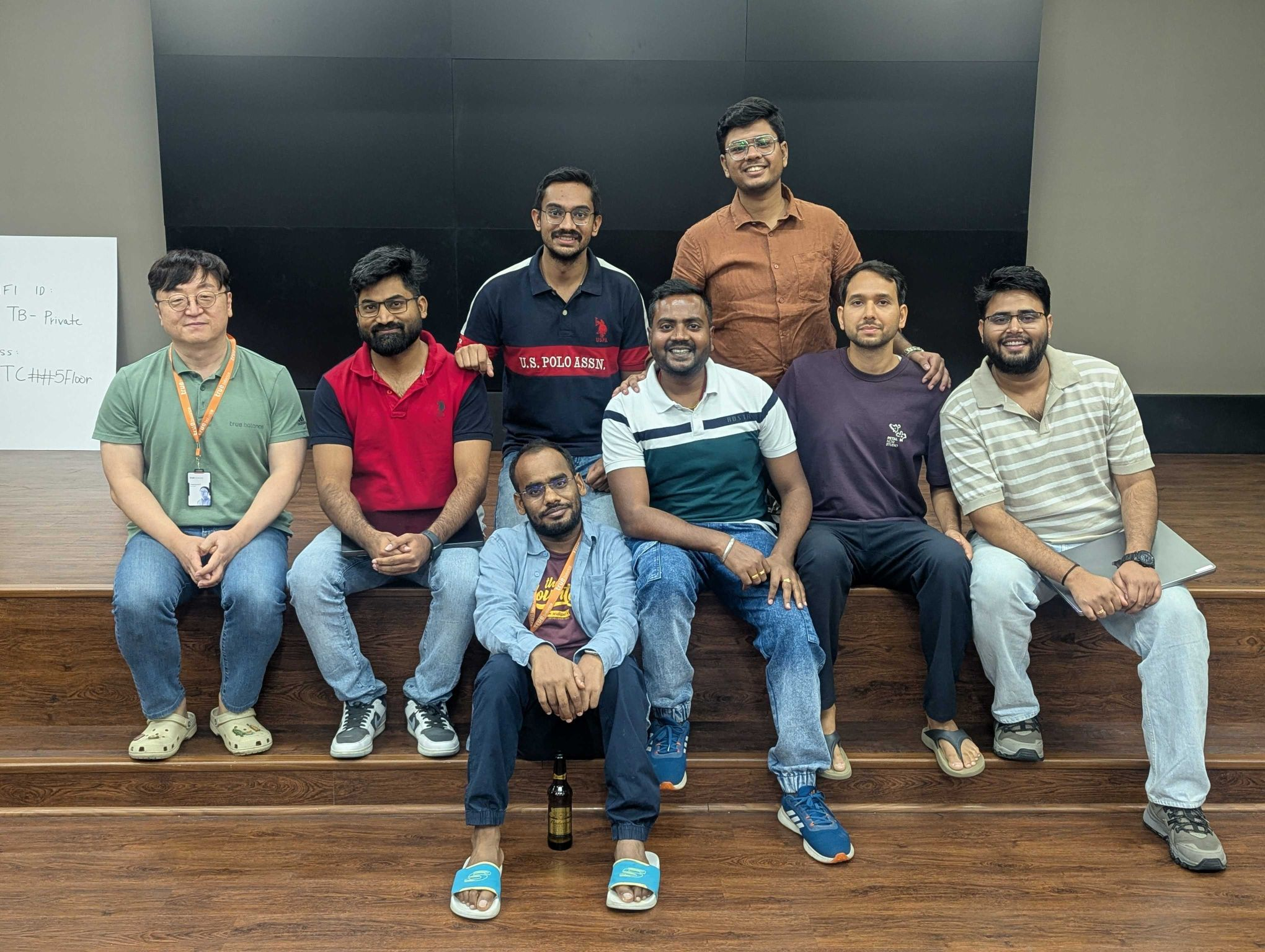
A Guest Post by Team TrueNeurons (Ved Verma, Jagrat Gupta, Lakshay Gupta, Sawan Kumar, Akash Kumar) – Winners of the True Balance AI Hackathon 2026
When we formed our team for the True Balance AI Hackathon, we didn’t just want to see how fast we could code. We wanted to solve a very specific, real-world frustration for our customers: the ambiguity of loan offers.
In the digital lending space, offers can sometimes feel like moving targets. We wanted to strip away that uncertainty and build a process where the customer knows exactly where they stand.
Here is a look at how we spent our 48 hours building an AI-driven engine to make repeat borrowing completely frictionless.
The Problem: The Friction of Starting Over
We started by mapping out the repeat borrower’s journey and immediately noticed a major disconnect.
When a customer successfully pays off a loan, they usually have to start the application process all over again for their next one. They have no visibility into their current eligibility or what their next loan amount might be until they go through the whole process. They did everything right, yet they are pushed back to square one.
This creates friction precisely at the moment we should be building trust and continuity.
The Solution: Visibility When It Matters
We realized that removing this friction meant providing clarity earlier in the journey. Customers shouldn’t have to wait until they close an account just to find out where they stand.
We built a system that leverages secure bureau checks and internal data to assess a customer’s ongoing eligibility against our repeat credit policy. Instead of making the user guess or wait, the system evaluates their profile to provide clear, upfront visibility into their future borrowing options while their current loan is still active.
This turns a loan closure from an abrupt stop into a smooth transition. By removing the guesswork, we make it easier for customers to plan their finances and give them a seamless, reliable path forward.

Building Faster with AI
To get a functional, production-ready engine built in just two days, traditional development cycles weren’t going to cut it. We leaned on generative AI to accelerate every single step of our workflow.
Here is what our toolkit looked like:
- Architecture & Logic: We used Claude Opus 4.8 to map out the system architecture and generate the core, production-ready code.
- Rapid Implementation: Cursor and Sidekick were our go-to tools for writing the implementation and doing live debugging on the fly.
- Design & Edge Cases: We leaned on ChatGPT and Gemini to brainstorm feature design, stress-test edge cases, and write out our documentation.
- Prototyping: Figma Make helped us spin up user experience prototypes incredibly fast.
We also made sure to create “AI-readable” feature documentation alongside the code. This means future developers can pick up our work and scale it with minimal effort.

One team, one spirit
The best part of the hackathon was the sheer energy of the sprint. We pushed late into the night, ran on almost no sleep, and came back the next morning ready to keep going.
Because we were moving so fast, job titles went completely out the window. Everyone just stepped up. Our Product Manager took over crafting the UX. Our backend engineers drove the core business logic. We only had one web developer on the team, but by using our AI toolkit, he managed to build out both the web and native Android experiences simultaneously.
Nerves were high during the live presentation, but watching our demo work flawlessly—exactly as we had designed it—was a massive moment of pride for all of us.
From Prototype to Production
We built this feature to actually ship it.
Right now, the concept is being reviewed by our Legal and Compliance teams for formal sign-off. While we wait on that alignment, we are polishing the design and making minor backend enhancements to ensure the architecture can handle complex edge cases.
Once we clear our comprehensive end-to-end QA testing, we are pushing this live. Ultimately, we are designing this as a modular, on-demand evaluation engine. Once it is in production, we can plug this exact same seamless experience into multiple entry points across the True Balance app.
Thank you to True Balance for giving us the runway to build this, and a huge congratulations to all the other teams who competed this month!


