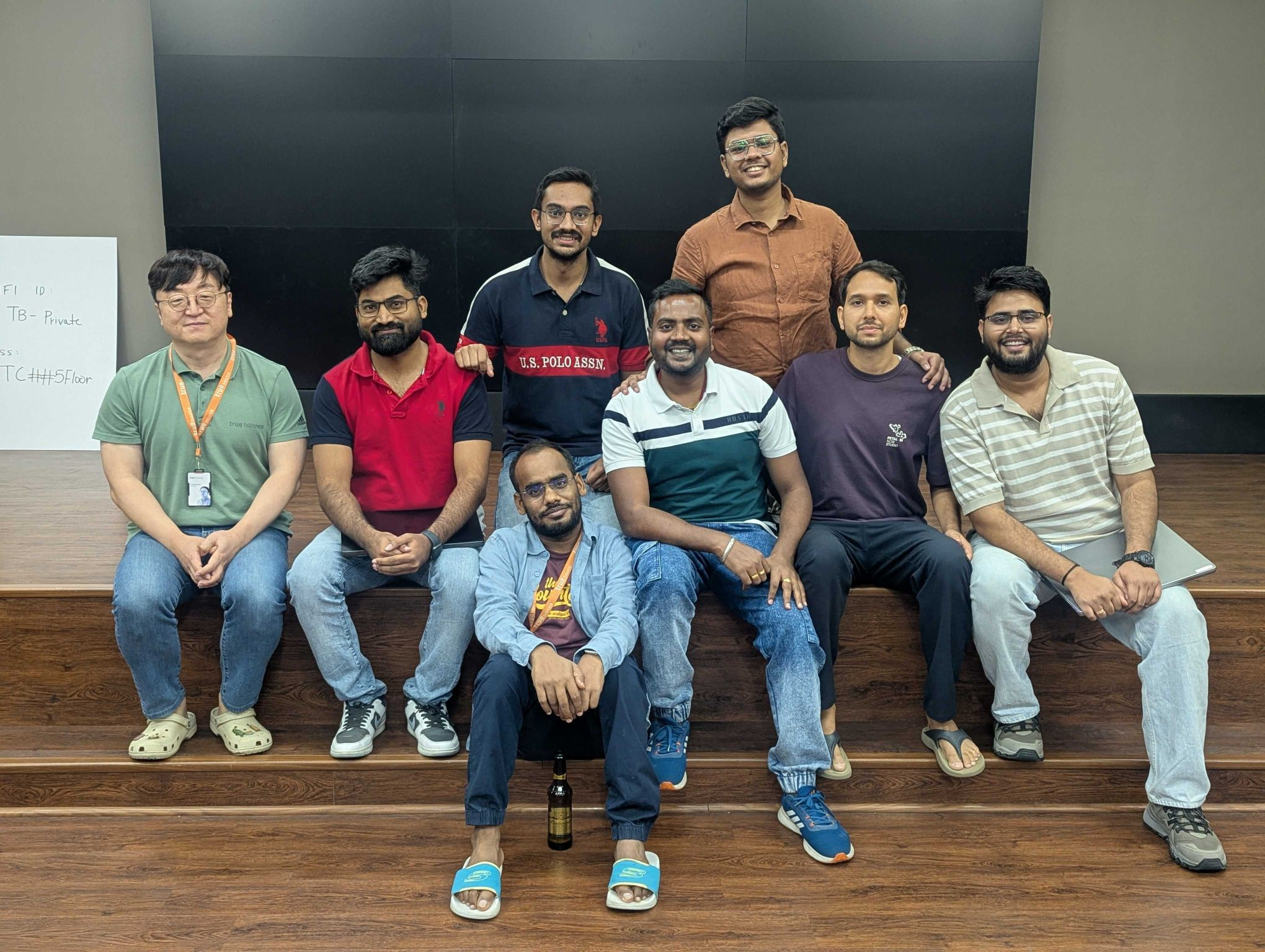
A Guest Post by Team Visionary Sages (Nishant Upadhyay, Surbhi Gupta, Shubham Soni) | Runner-up, True Balance AI Hackathon 2026
Our team consists of product designers, not software engineers. During the True Balance AI Hackathon, however, presenting a simple Figma prototype wasn’t enough. We wanted to build a live, working solution. Thanks to AI development tools, that goal became a reality.
Here is the problem we set out to solve: A customer finishes a loan application. They pass the screening and get fully approved. Then, the user just stares at the screen.
The app was showing three different offers—a ₹40,000 Cash Loan, a ₹15,000 Level Up Loan, and a ₹75,000 Partner Loan. Each had different rates, fees, and timelines. All of this information was appearing on a 360-pixel mobile screen with no guidance.
Despite getting all the way to this final screen, fully approved people were dropping off. Finding out ‘why’ became our main focus. After digging into the data, our team identified three distinct friction points and built Hambal AI to solve them. Looking back, the hardest part of the build wasn’t the AI itself. The real challenge was figuring out how to constrain the AI so it was actually safe for a financial product.
Why Users Dropped Off
Expecting people to make a complex financial decision in a vacuum is a recipe for drop-offs. We broke the friction down into three categories:
- Comparison Overload: Put three entirely different loan products side-by-side, and people may get confused. They usually end up picking the biggest number, the one they barely understand, or they simply close the app.
- The Comprehension Gap: Imagine borrowing ₹40,000 but seeing a higher total repayment amount. If the processing fees and interest aren’t clearly explained upfront, the immediate human instinct is to assume it’s a trap.
- Invisible Flexibility: True Balance actually offers ways to minimize missed payments or prepay or foreclose as per their convenience.. But that information was buried in the terms and conditions, leaving users feeling like they had zero safety net.
The company already held all the data needed to fix this. Our platform just wasn’t putting it in front of the user when it mattered most.
Two Screens, Two Jobs

Hambal AI operates in two specific modes, depending on where the user is stuck.
On the ‘Offer List’ screen, the tool’s job is comparison. It helps reduce decision paralysis by matching the user’s real income and purpose to the right loan, rather than blindly pushing the highest-margin product.
Once the borrower clicks into the ‘Loan Detail’ screen, the job changes to comprehension. The AI walks them through the math, explains the repayment total, and highlights the flexibility options.
To make this feel natural, a dynamic chip system was built. Instead of a static FAQ, the suggested questions update based on the last answer. If a user taps “How much will I receive?”, the next chips automatically shift to “Why do I pay back more?” or “What are these fees?”
The Math-Free AI Architecture
In lending, a single hallucinated number is a massive compliance failure. Our design team solved this by moving the math out of the Large Language Model entirely.
When someone asks a question, the backend does the actual thinking. The system classifies the intent, ranks the offers, and calculates every fee and monthly payment deterministically. From there, it hands the AI an already-sorted set of offers with exact, hard-coded figures.
Writing a short, human-readable caption and generating the next follow-up chips is the LLM’s only job. This model never sorts, never picks an offer, and never calculates a figure. Because it doesn’t do any math, misquoting a fee becomes impossible.

From Figma to Production: A Designer-Led Build
Usually, a feature this complex requires writing a heavy product brief, handing off UI files, and waiting months for engineering bandwidth. This time, our design team built it directly.
By using AI tools to handle the heavy lifting of the code, we didn’t just map out a conversational flow in a design tool. Instead, we architected a production-ready backend service. The process involved setting up the routing logic, handling the database calls, and deploying the streaming infrastructure.
Data security was built in from day one. Only a secure session token is sent by the mobile app, allowing the backend to resolve it without exposing our architecture. Furthermore, the LLM has absolutely no say in whose data is fetched.
Shipping Hambal safely required isolating the AI logic from the core Android app. Zero existing ViewModels or Repositories were modified. Everything streams over Server-Sent Events, ensuring the conversational text feels alive while the mathematically perfect UI card renders instantly.

What’s Next
Entering this hackathon as designers, we left having built a shippable backend service. This experience proved that AI removes the bottleneck between seeing a user problem and actually fixing it.
Next up is voice integration. Borrowers heavily prefer using voice commands in Hindi or other vernacular languages. Since the conversational text is already decoupled from the financial math, adding voice is as simple as putting a speech-to-text layer in front of our endpoint. The underlying math stays untouched, deterministic, and safe.